Bury District Angling Society
BackBury District Angling Society is a long‑established members’ club that provides access to multiple stillwaters and stretches of running water for coarse and carp fishing, with a strong emphasis on structured rules and a community‑run approach. Anglers looking for dedicated club waters rather than commercial day‑ticket venues will find a network of lakes and reservoirs that aim to cater for different styles of coarse fishing, from pleasure sessions to more focused specimen hunting.
The society operates as a not‑for‑profit group run by anglers for anglers, which appeals to those who like to see membership money reinvested into fisheries, infrastructure and bank maintenance rather than shareholder profit. Members gain access to several club waters, including well‑known venues such as Dearden’s Carp Fishery and larger open waters like Elton Reservoir, alongside lodges and smaller lakes that are more intimate and suited to traditional coarse methods. This structure allows the club to offer variety without forcing anglers into a one‑size‑fits‑all style of fishing.
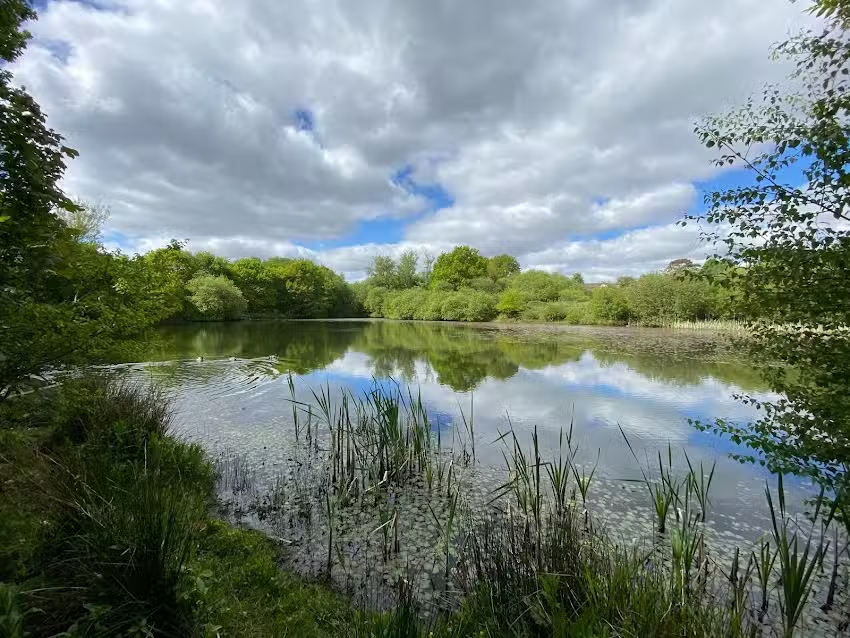
Access to a portfolio of waters is one of the club’s strongest assets for anyone who spends a lot of time on the bank. Instead of paying separate fees for each venue, anglers can work through a list of lakes such as Dearden’s, Big and Little Carcass, Field Lodge, Island Lodge, Cartwheel Lodge and sections of the Kirklees Brook under a single membership, which can be particularly attractive for regulars who enjoy rotating between different waters and target species. This setup effectively gives local anglers a compact network of coarse fishing lakes and club carp waters without the need to travel long distances.
From a freshwater angling perspective, the spread of venues means both pleasure anglers and specimen‑orientated members have realistic options. Club information highlights Dearden’s Carp Fishery as a dedicated carp water, positioned within the membership structure as a premium option for those who want more focused carp angling. Meanwhile, the valley waters and lodges give scope for mixed catches, with species such as carp, bream, roach and perch featuring prominently and providing a more traditional club‑water experience. For many local anglers, having that mix under one umbrella is more attractive than a single commercial lake heavily centred on one species.
Rules and terms are clearly laid out, which is reassuring for anglers who value fish welfare and structured bank behaviour. The club requires all members to carry a valid club permit and Environment Agency rod licence at all times on its waters and states explicitly that failure to produce them can result in being asked to leave and reported to the authorities. Night fishing is reserved for members, fishing is from designated pegs only, and there are restrictions on tackle such as a ban on braided main line and braid shock leaders. Requirements around cradles, nets and safe fish handling underline a desire to protect stocks and keep the waters to a decent standard.
This relatively strict framework will suit anglers who like to know that rules are enforced and that fish are being looked after with some consistency. Peg‑based fishing, limitations on fishing zones for safety reasons and clear expectations regarding permits all contribute to a controlled environment, which can help maintain order on the bank and reassure families and junior members. For those used to regimented club waters, Bury District Angling Society feels familiar in its approach.
On the other hand, some anglers see the same firm rulebook and enforcement style in a much less positive light. A number of online comments refer to disciplinary decisions that feel heavy‑handed, with at least one former member claiming to have been banned indefinitely after taking a guest on the bank while dealing with a separate harassment issue and not feeling comfortable fishing alone. Such feedback suggests that the club’s drive to enforce rules can sometimes come across as rigid, and that communication around bans and sanctions may not always leave members feeling fairly treated.
Concerns also surface around fishery management and on‑the‑bank presence. There are opinions describing fishery management skills as non‑existent, alongside criticism of poor policing of waters and underperforming bailiffs. These negative experiences stand in stark contrast to other comments praising the club as offering the best club water in the North West, which points to a very mixed pattern of satisfaction. For a potential member, this means expectations should be set carefully: the quality of a session may depend on which water is chosen, what is happening with bailiff cover at the time and how well rules are being enforced on that particular venue.
Communication is another area where the picture is uneven. One recent online question about whether a specific water holds pike and what the exact rules are for that lake remained unanswered in public view, which can give the impression that information is not always easy to obtain. For modern coarse anglers who are used to active social media groups and responsive fishery managers, a lack of reply to basic questions can be off‑putting and may push some people towards more interactive clubs. That said, the club has invested in an online system for memberships and day tickets, and its rules are set out clearly in digital form, so there is at least a framework in place for more transparent communication if it is used consistently.
Pricing and membership options sit in the typical range for a multi‑water angling club. There are standard senior, concession and junior memberships, with additional tiers for access to specific carp waters such as Dearden’s, and online purchase is now the default for both memberships and day tickets. This will suit most anglers who are comfortable paying online and managing their fishing through a digital account, though it may feel less convenient for those who prefer to deal with a club representative in person. Day tickets, where available, are linked to defined times and require anglers to have their receipt accessible on the bank along with the correct licence.
From a pure angling standpoint, the variety of waters is the main attraction. Having club access to different styles of venues means members can focus on different aspects of coarse fishing as they wish: one week might be about traditional float fishing for silvers on a lodge, the next about setting up heavier tackle for carp on a larger pit or reservoir. This makes Bury District Angling Society a potential “home base” for anglers who want to develop a broad set of skills rather than being locked into only one style of fishing. The club’s structure effectively gives local anglers a small network of angling club lakes and carp fishing venues without the fragmentation of multiple individual tickets.
At the same time, prospective members should factor in the inconsistency in member satisfaction shown in online comments. While some anglers consider the waters to be among the best in the region, others are frustrated by fishery management, bailiff presence and the way disciplinary issues are handled. Club waters inevitably involve compromise between diverse personalities and expectations, and Bury District Angling Society appears to be no exception. Those who thrive in structured environments and are prepared to work within a clear rulebook are more likely to feel at home than those who prefer a relaxed, informal atmosphere.
For anglers comparing options, Bury District Angling Society offers a multi‑water membership with access to a range of coarse and carp venues, a firm stance on permits and fish welfare, and a community‑run ethos that appeals to many club anglers. At the same time, potential members should be aware of criticisms about fishery management and rule enforcement, and consider whether the club’s culture matches their own approach to fishing. Used in the right way, the society can act as a useful gateway to a network of coarse fishing venues and club carp fisheries, especially for those who plan to be on the bank often enough to make full use of the waters included in membership.