
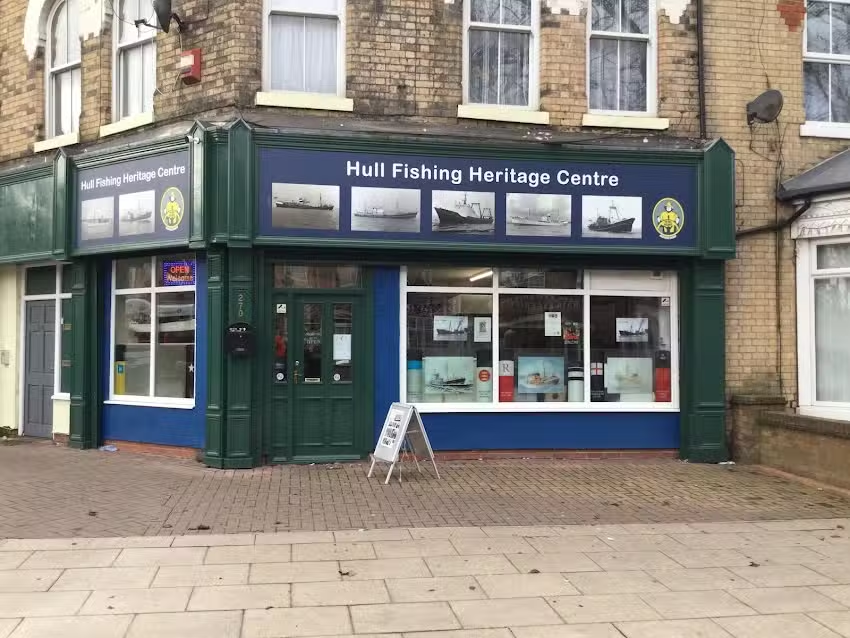
Hull Fishing Heritage Centre
BackHull Fishing Heritage Centre is a small, independent museum dedicated to preserving the story of Hull’s deep‑sea fishing industry and the people who worked in it, with a particular emphasis on life aboard deep sea trawlers and within the tight‑knit Hessle Road community. Visitors will find an intimate space filled with personal memories, models and artefacts rather than a large, corporate attraction, and this character shapes both its strengths and its limitations for anyone with an interest in maritime history or commercial fishing.
One of the centre’s main strengths is the way it brings history to life through direct contact with former trawlermen who now act as volunteers and informal guides. Instead of scripted talks, visitors are typically welcomed with a friendly chat, sometimes even a cup of tea, and taken around in a conversational style that mixes factual detail with first‑hand stories of harsh weather, long trips to the fishing grounds and the impact of lost vessels on families back home. This personal approach appeals to people who want more than dates and names; it offers insight into what it actually meant to work in the North Atlantic in small fishing boats and to risk your life to put fish on the nation’s tables.
The collections themselves reflect a strong focus on Hull’s role as a major fishing port, with a particularly notable display of model trawlers representing different eras of the fleet. These carefully crafted vessels are supported by paintings, prints and photographs that show ships at sea, dock scenes and the everyday environment of fish processing and landing catches. Ship’s bells, navigation instruments and other pieces of working gear provide a tactile connection to the past, helping visitors imagine the conditions aboard working fishing vessels rather than simply reading about them.
Beyond physical artefacts, the centre also serves as a resource for family history and research linked to fishing crews and local seafaring families. There is a substantial archive that includes day records from trips, images of crews and a large catalogue of historic photographs, which can be invaluable if you are tracing relatives who worked on Hull trawlers. Several visitors mention being helped to find a grandparent’s name on memorial boards or being offered further research into family members who were lost at sea, underlining how the centre functions as an informal research service, albeit one that depends on volunteer time and availability.
The memorial element is important, particularly for those with personal links to the industry. Outside and nearby there are dedication boards and plaques commemorating more than 6,000 men who left Hull to work on fishing boats and never came home, along with benches and murals that mark significant vessels and tragedies. Visitors often comment on the emotional impact of seeing a relative’s name or realising the scale of loss associated with deep sea fishing, especially during periods when safety standards were less rigorous than today.
The centre’s role in the community extends beyond being a static museum, functioning as a social hub where ex‑seafarers, families and local residents can meet, reminisce and share stories over a drink. Former trawlermen use the space to pass on memories of the Hessle Road area, from its shops and pubs to its role as a ‘village’ within the wider city, and visitors often remark that you leave feeling you have met people rather than simply looked at displays. This community‑driven culture can be particularly appealing if you want an authentic picture of fishing industry life rather than a polished, purely visual exhibition.
From a practical perspective, the centre is run entirely by volunteers, largely ex‑trawler crew, and admission is free with donations encouraged to help cover running costs that are reported to be substantial each year. For potential visitors, this makes it a low‑cost option, especially for families or groups, and you are likely to feel that your contribution goes directly towards keeping a grassroots heritage project alive. The downside is that, as a volunteer‑led charity, staffing levels and opening arrangements can be more vulnerable to change than in larger institutions, and this affects reliability.
Most accounts describe a warm welcome and staff who go out of their way to help, whether that means answering detailed questions about specific fishing fleets or taking time to support someone researching a relative lost at sea. Visitors praise the patience and knowledge of people such as Jerry and other volunteers, who are willing to adjust the depth of information depending on whether you are a casual visitor, a student or someone with a professional or personal interest in the sea fishing industry. This level of personal service stands out when compared with larger maritime museum environments where contact with staff can be limited.
However, potential visitors should be aware of some recurring criticisms that arise precisely because the centre relies on volunteers and limited funding. A small number of people report arriving during the day to find the building closed despite published times, leading to wasted journeys and disappointment. Others note that communication about hours and closures could be clearer, particularly for those travelling from further afield who have planned a trip around a visit to the centre. This lack of predictability can be frustrating if you are trying to fit the visit into a tight schedule.
The physical scale of the centre also influences the experience. It is often described as compact, with displays arranged in a relatively small footprint compared with larger fishing museum sites. For many visitors, this is a positive feature because every corner is densely packed with models, photographs and memorabilia, and you can have in‑depth conversations without feeling overwhelmed. That said, anyone expecting a large‑scale attraction with interactive digital exhibits, extensive fishing gear displays and multiple galleries might find it more modest than they anticipated.
For those specifically interested in the technical side of trawler fishing and fishery operations, the centre provides a good starting point rather than a full technical archive. Model trawlers, navigational instruments and photographs offer glimpses into vessel design and equipment, while volunteers’ stories fill in details about working practices, safety campaigns and changes brought about by events such as the ‘triple trawler tragedy’ and subsequent reforms. Visitors who need detailed engineering or policy information may still need to consult additional archives, but the human perspective here gives context to the statistics and documents they may encounter elsewhere.
Families and school groups often find the centre engaging because children can see scale models of fishing boats, life‑sized figures and real gear while hearing stories that make those objects meaningful. The relatively informal setting means that youngsters can ask direct questions about life at sea, weather conditions, catch sizes and the dangers of commercial trawling, with answers adapted to their age and level of understanding. Teachers and group leaders tend to appreciate how volunteers convey both the pride and the hardship associated with the industry, making it easier to discuss topics such as risk, community support and change over time.
Accessibility is another consideration. The centre has an entrance that is reported to be suitable for wheelchair users, which is important given the age profile of many visitors and volunteers. The compact layout can make some areas feel busy when several people are inside, but it also means that those with limited mobility do not have to cover long distances to see the main displays. As with other aspects of the centre, individual experiences can vary depending on how crowded it is at the time of your visit.
For anyone with a connection to Hull’s fishing trade, whether through family history, professional interest or simple curiosity, the Hull Fishing Heritage Centre offers an experience built on authenticity, personal stories and community memory rather than on large budgets or high‑tech installations. The informal guided conversations with ex‑trawlermen, the detailed models of fishing trawlers and the memorials to those who never came home provide a powerful sense of what this industry meant to the city and its people. At the same time, a reliance on volunteers and donations means that opening arrangements and facilities can sometimes feel fragile, so it is wise to treat any visit as an opportunity to support a grassroots project as well as to learn about the history of sea fishing.