Ringwood Lake Angling Club
BackRingwood Lake Angling Club is a well-regarded coarse fishery that attracts anglers who want realistic chances of quality fish rather than a heavily commercialised venue. The club manages the water under agreement with the local authority and presents itself as a friendly, value-focused organisation where day tickets and permits are designed to offer good access to specimen-sized fish without excessive cost. This balance of accessibility and challenge defines much of the experience here, with regular visitors highlighting the lake as somewhere that can produce memorable sessions if you are prepared to think carefully about your approach.
One of the strongest attractions of Ringwood Lake Angling Club is the variety of species on offer. Anglers report consistent sport from carp, roach and bream, reflecting the council’s description of their lakes as being well stocked with coarse fish. Club content and videos emphasise that the water is capable of producing specimen-sized fish of several species, making it appealing to those who enjoy targeting different quarry through the seasons. For those searching online for a versatile venue, terms such as carp fishing, coarse fishing and predator fishing all align naturally with what this lake can offer.
For many visitors, the headline draw is the carp. The club promotes the fact that the lake can produce specimen fish, and social media discussions about Ringwood waters refer to multiple fish over the mid‑forty-pound mark across the club’s portfolio, though the specific stock here is described more modestly as strong and capable rather than extreme big‑fish territory. Anglers who have shared their experiences talk about seeing large carp moving in the pads and margins and about pegs that have produced excellent catches in both summer and winter when conditions line up. This makes Ringwood an attractive option for dedicated carp anglers looking for a water with genuine potential without venturing to crowded holiday-type venues.
Feedback from visitors suggests that it is possible to encounter striking individual fish. One angler described their first session at Ringwood resulting in a koi approaching fifteen pounds, praising both the condition of the fish and the general cleanliness of the water. Such comments underline the perception that the stock is not only capable of producing good weights but is also kept in sound health. When combined with the emphasis on unhooking mats, appropriate landing nets and line strength in the club’s rules, there is a clear message that fish welfare is taken seriously. For those comparing different fishing lakes in the area, this focus on care can be an important deciding factor.
Predator fishing is another element that adds depth to the venue. The club operates a defined pike season running from early October to the end of March and sets additional requirements for tackle such as large landing nets, substantial unhooking mats, appropriate mainline and wire traces. These rules are supported by guidance that pike must be handled with particular care, reflecting the lake’s reputation for housing worthwhile predators and the need to protect them. For anglers looking for pike fishing opportunities in a controlled environment, this structure can be reassuring, even if it introduces extra cost in terms of specialist equipment.
Ringwood Lake Angling Club publicly frames its pricing as offering strong value for money, with the claim that anglers would struggle to find another Derbyshire venue that matches both the price and the chance to catch specimen-sized fish. While individual opinions on value will always vary, online comments and the modest but positive set of reviews suggest that regulars feel they receive a fair return in terms of sport for the fees they pay. For many local anglers, being able to buy a day ticket and genuinely target better fish at a manageable cost is a key reason to choose this club over more commercial day ticket fisheries.
Facilities, access and bankside environment
The physical layout of Ringwood Lake is often mentioned by visiting anglers. Video walk‑throughs point out pegs that offer enough space for a bivvy and rod pod, as well as steps and access points that make the banks workable for longer sessions. Some swims are described as especially productive for carp, particularly at certain times of year, while other areas lend themselves more to pole or feeder tactics for bream and roach. This variety helps keep the venue interesting, giving both pleasure anglers and more serious specimen hunters viable options around the lake.
At the same time, not every part of the bank is currently easy to use. Anglers have highlighted stretches that have become heavily overgrown or subject to erosion, reducing the number of practical pegs and making some areas effectively unfishable unless you are very mobile and prepared to tackle rough ground. There has also been discussion about gates or barriers installed near certain platforms that appear to limit direct access unless someone comes to unlock them, which some see as a safety or maintenance measure and others view as an inconvenience. For potential visitors, this means that while the venue offers attractive swims, it is sensible to expect a few sections that feel more restrictive than purpose‑built commercial complexes.
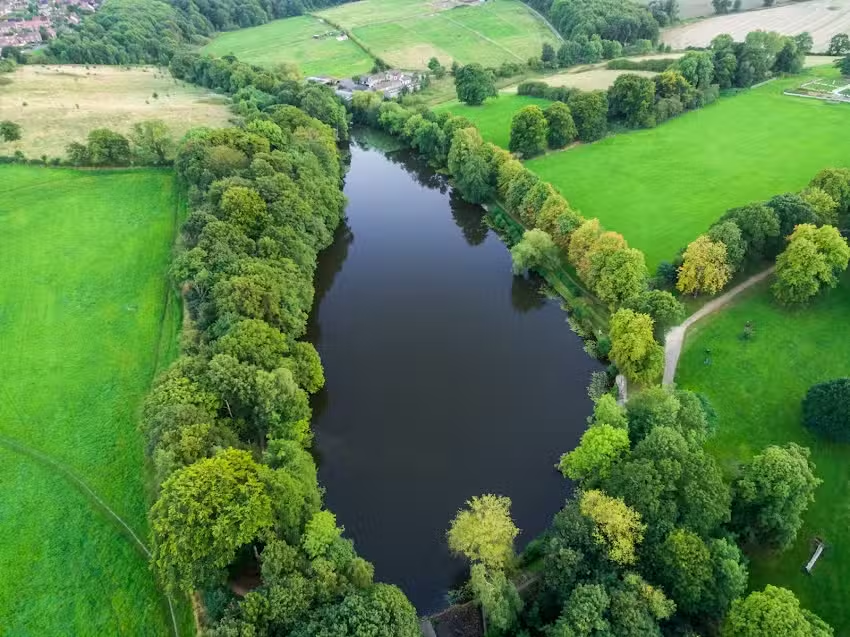
One positive aspect for many is that the lake benefits from a feeling of space and a semi‑natural setting rather than a tightly packed grid of platforms. Anglers mention shallow bays, reed lines and pads that provide obvious holding spots for fish and respond well to careful presentation. These features appeal particularly to those who enjoy watercraft and stalking, as opposed to simply casting to numbered markers. However, the same natural feel also means that ground conditions can be muddy in wet weather and paths may not always be as even as on more manicured commercial fishing venues.
Rules, fish welfare and club culture
Ringwood Lake Angling Club publishes a detailed set of rules aimed at protecting both anglers and fish. Requirements include holding a valid Environment Agency licence, using barbless hooks for general coarse and pike fishing, and micro‑barbed hooks only for carp, along with bans on fixed leads and braided main line for carp setups. The club insists on unhooking mats and adequate landing nets, and it strongly discourages any removal of fish or unauthorised cutting of trees and aquatic plants. These measures reinforce the impression of a fishery that wants to balance accessibility with responsible angling.
There are also behavioural expectations that shape the atmosphere on the bank. Members are required to keep pegs clean, dispose of litter in provided bins and avoid alcohol and drugs while on site, with the threat of being asked to leave if they are found under the influence. Respect for other anglers is specifically mentioned, which can help reduce confrontations over noise or encroachment on swims. For many potential visitors, especially families or those planning longer carp sessions, this emphasis on order and respect can be attractive compared with more chaotic fishing lakes where rules are loosely enforced.
However, the same rules and club structure may feel restrictive to some. Night fishing, for example, is limited to a subset of members and requires direct contact with a named individual to arrange. For casual anglers who only fish occasionally after work or prefer spontaneous overnight trips, having to obtain specific permission can be a drawback. Similarly, the prohibition on tins on the bankside and the requirement for particular terminal tackle might be seen as extra hassle by those used to more relaxed day‑ticket fisheries, even if these measures are intended to prevent litter and protect fish.
Fishing experience and catch potential
Accounts from anglers suggest that Ringwood is not a guaranteed bag‑up venue but can be very rewarding for those who invest time in understanding it. Video commentary highlights that some pegs can be outstanding for bream on the pole and feeder, with reports of highly productive sessions when fish are shoaled up. Similarly, there are stories of winter days where the shallower end of the lake has out‑fished the deeper section, showing that the water does not always behave in the most obvious way and that observation pays off. This gives the venue appeal to more experienced coarse anglers who enjoy working a water out rather than relying solely on heavy feeding.
For carp specialists, the lake offers a mix of open water spots and margin features, with anglers noting visible fish moving around pads and natural inlets. Some swims provide enough room for bivvies and multiple rods, which suits those planning multi‑day sessions with typical modern carp tactics. Although this is not a heavily stocked commercial water where double‑figure carp are guaranteed every visit, the presence of larger fish and the chance of a specimen means that patience can be rewarded. For many searching terms such as specimen carp lake or carp day ticket, this kind of balance between challenge and opportunity is exactly what they are seeking.
Pike anglers have a defined window in which to target predators, and the dedicated rules indicate that the club expects a certain level of competence from those fishing for them. This can mean that complete beginners may feel more comfortable starting with the coarse fishing before moving into predator tactics, especially as large landing nets, wire traces and long forceps are mandatory. On the other hand, for experienced predator anglers who want a water where pike are treated seriously, these requirements are likely to be seen as a positive sign. The result is a venue that sits comfortably on lists of pike fishing lakes with sensible, welfare‑driven management.
Strengths and areas for improvement
Looking at feedback as a whole, Ringwood Lake Angling Club enjoys a positive reputation amongst those who use it regularly. Comments highlight good fish condition, realistic chances of better fish, a friendly atmosphere and a clear rule set that aims to keep the venue tidy and safe. The club’s own messaging about value and opportunity feels consistent with what anglers report, especially for those seeking a multi‑species venue rather than a single‑species commercial. For people searching online for a dependable angling club with coarse, carp and predator options, these strengths make Ringwood a serious candidate.
There are, nonetheless, aspects that some visitors regard as less favourable. Bank erosion and overgrowth have reduced access in certain areas, which can be frustrating when you know that historically productive pegs are now awkward to reach or no longer officially usable. Discussions about paths and responsibility for maintenance show that there can be ambiguity between the club and local authority over who should address specific issues, which may lead to delays in improvements. For anglers who expect perfectly manicured paths and uniformly spaced platforms from a commercial fishery, this more natural and occasionally unkempt setting may feel like a step down.
The restricted nature of night fishing and the need for particular tackle standards may also put off some casual visitors. Those who fish only a few times a year, or who are used to buying a simple day ticket and casting out without much scrutiny, might find Ringwood’s structure slightly formal. On the other hand, anglers who care deeply about fish welfare and order on the bank are likely to view these rules as a sign that the water is being looked after. As with many coarse fishing lakes, whether this feels like a strength or a weakness depends largely on the individual angler’s expectations and style.
Overall, Ringwood Lake Angling Club comes across as a venue that aims to provide serious but accessible fishing rather than instant, heavily stocked sport. Its combination of carp, coarse and predator opportunities, clear welfare‑focused rules and reasonable value makes it appealing to a broad range of anglers who are willing to adapt to its quirks. Potential visitors considering where to spend their next session should weigh the promise of well‑conditioned fish and a varied water against the reality of some bank wear, access limitations and more structured rules, then decide whether that mix matches their own expectations of a quality fishing lake.