
St Andrews Angling Club
BackSt Andrews Angling Club operates as a long‑established, membership‑based fishery at Cameron Reservoir, providing access to bank and boat fishing in a setting that balances angling with protected wildlife interests. The club leases the fishing rights and manages the water primarily for trout, keeping a focus on traditional fly‑fishing and a community feel rather than a highly commercial, high‑pressure venue.
One of the strongest attractions for potential visitors is the quality of the trout fishing on offer. Cameron Reservoir holds a resident population of brown trout and is regularly stocked with hard‑fighting rainbow trout, which gives anglers a realistic chance of sport across much of the season. Comments from experienced visitors describe powerful, energetic fish that provide a satisfying test on typical fly‑fishing tackle, which is exactly what many anglers seek from a managed stillwater. For those looking for a dedicated trout fishing venue rather than a mixed coarse fishery, this focus is likely to be a clear positive.
The club emphasises fly fishing, with anglers casting weighted lines and artificial flies to imitate natural insect life on and around the reservoir. Members interviewed in local media highlight how the water encourages proper technique, from smooth acceleration of the rod to controlled presentation, and that the process of learning to cast well here is rewarding in itself. For newcomers who want to get into fly fishing, having experienced members on hand and a water that suits boat and bank tactics can be a significant advantage, although it may feel challenging at first for those who are completely new to the method.
Cameron Reservoir offers both bank and boat access under the club’s management, giving anglers flexibility in how they approach the water. Bank anglers can cover a substantial shoreline, while small boats allow access to open‑water drifts and less‑pressured lies, which many fly‑fishers value when targeting cruising rainbow and brown trout. Reports and recent social media posts mention more boats going back into the water as conditions improve, which is encouraging for those who prefer drifting and searching tactics with intermediate or floating lines. The flip side is that demand for boats at popular times can be high, so some planning ahead is usually necessary to secure a preferred session.
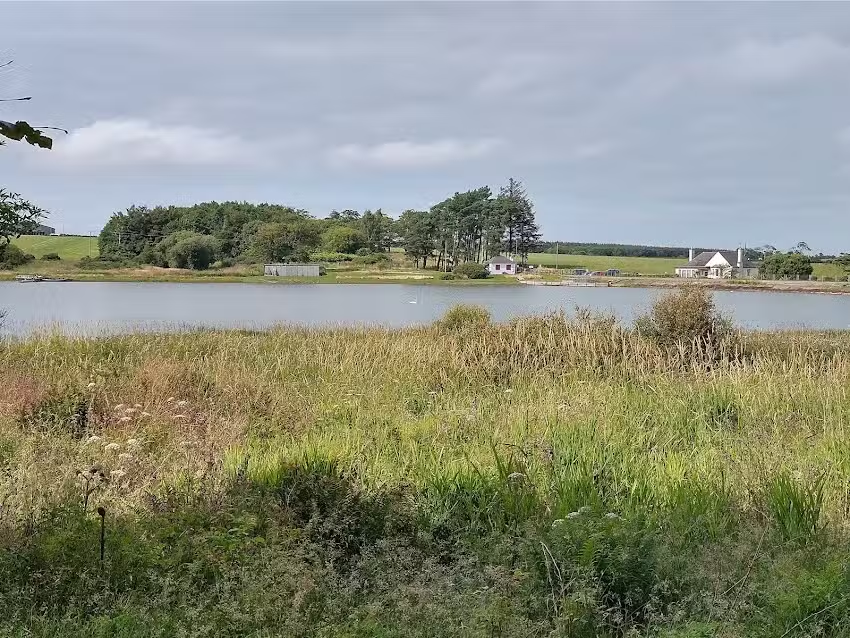
The overall setting is often described as peaceful and restorative, which adds to the appeal for anglers who see a day’s fishing as a chance to unwind as much as to catch fish. Club members talk about visiting after work or at weekends simply to enjoy fresh air, quiet water and unhurried conversation on the boat, sometimes not minding whether they actually catch a trout or not. For many, this atmosphere is a key reason to choose St Andrews Angling Club over more intensively stocked commercial ponds that can feel crowded or pressured. However, anglers who prioritise high catch rates and constant action above all else might find this water more about steady, thoughtful fishing than guaranteed multiple‑fish bags.
From a practical standpoint, Cameron Reservoir is reachable by car, bus or bike, which is helpful for both local residents and visiting anglers staying in the area. There is a small car park near the loch and a circular path of roughly two and a half miles around the water, which makes access on foot straightforward for those comfortable with a moderate walk. Paths on the south side are described as rougher underfoot, so anglers carrying tackle or moving between spots should be prepared for uneven ground and potentially muddy stretches in poorer weather. For anyone with limited mobility, this may restrict which sections of bank are realistically usable.
The club’s management of the fishery reflects the reservoir’s dual role as both an angling venue and a protected wildlife site. Cameron Reservoir holds international conservation designations for its populations of wintering waterfowl, including pink‑footed geese, and is recognised as a Site of Special Scientific Interest. As a result, St Andrews Angling Club operates within clear environmental responsibilities, encouraging careful behaviour on the banks and on the water, and promoting respect for habitats and birdlife. For many anglers this is a positive, as it means fishing takes place in a genuinely natural environment, though it does mean that some forms of bank clearance, ground baiting or noisy activity that occur at more commercial venues are not appropriate here.
The wider surroundings of Cameron Reservoir are popular with walkers and birdwatchers, and this shared use has both benefits and potential drawbacks for anglers. On the positive side, the presence of wildlife and the variety of habitats around the loch add interest to a day’s fishing, and many visitors remark on the abundance of songbirds, waterfowl, wildflowers and butterflies along the circular path. The mixture of recreational users helps keep the area feeling safe and well‑used rather than isolated. On the other hand, during busier periods anglers may need to be patient and considerate when back‑casting near paths or when manoeuvring boats close to shore, and those who prefer complete solitude might occasionally find the level of foot traffic distracting.
In terms of membership and access, St Andrews Angling Club aims to remain accessible while still functioning primarily as a members’ club. Different forms of access exist, including memberships and day permits, allowing both regular local anglers and occasional visitors to fish the reservoir. There are specific concessions such as a student membership at a reduced rate, which can be attractive for those studying nearby who want a dedicated stillwater to fish throughout the season. Prospective visitors need to factor in that they cannot simply turn up and fish without arranging access, which is different from some open‑access fishing lakes or public fishing ponds, but this system does contribute to controlled angling pressure and better stock management.
Stock management is an important part of the club’s operations. The reservoir is no longer used as a domestic water supply and now serves as a managed trout fishery, with stocking taking place regularly to supplement the existing wild brown trout population. Social posts from the club highlight fresh introductions of quality rainbow trout, often timed around the start of suitable weather windows, and this helps to sustain a reasonable level of sport through the year. That said, the water is not promoted as an easy “put‑and‑take” venue where every angler is guaranteed quick limits; conditions, fly choice and technique still play a major role in success, especially when weather or water temperature are less favourable.
For those comparing potential venues, St Andrews Angling Club stands out more as a traditional stillwater trout fishery than as a multi‑species destination. Anglers seeking carp, pike or coarse fishing may find that this is not the ideal choice, as the emphasis remains firmly on trout and on fly tactics instead of bait or spinning approaches. This specialisation can be very appealing for fly‑fishers who want a focused environment to refine their skills, try different patterns and work with the wind and contours of an upland reservoir, but it makes the venue less versatile for mixed‑method groups or families wanting a simple bait‑fishing session.
Feedback from visitors and members tends to highlight a welcoming, down‑to‑earth attitude among regulars. Those who fish with club members often mention helpful advice about techniques, drifts and fly patterns, as well as a sense of shared enjoyment of the water rather than intense competitiveness. For newer anglers, this can make the first few trips less intimidating and helps shorten the learning curve of reservoir fly fishing. However, anyone hoping for on‑site tuition, hire tackle or shop‑style facilities may find that the club is more informal and community‑based than a large commercial fishing tackle centre, so it is sensible to arrive prepared with suitable gear and basic skills.
Weather conditions at Cameron Reservoir can be changeable, which is typical of exposed waters in this part of Scotland but still worth noting from an angling perspective. Visitors mention days where rain has set in for hours yet the location remains attractive, just with a more challenging environment to fish in. At certain times of the year, anglers and other visitors have remarked on large numbers of flies around the reservoir, which can be slightly uncomfortable when driving or walking, though they are not necessarily biting insects and can, in fact, reflect the richness of the insect life that supports trout growth. Sensible clothing, eye protection and a willingness to adapt to wind and rain are important for making the most of any session here.
For potential visitors looking specifically for dedicated fishing lakes or a managed stillwater to target trout, St Andrews Angling Club at Cameron Reservoir offers a mixture of quality fish, tranquil surroundings and traditional fly‑fishing practice under responsible management. Its strengths lie in the character of the water, the balance between stocked rainbows and wild browns, and the calm, social atmosphere that regulars describe. Limitations mainly relate to its focus on fly‑fishing for trout rather than other disciplines, the need to arrange membership or permits in advance, and the natural constraints of a protected site shared with walkers and wildlife. For anglers who value authenticity, careful stewardship and a peaceful day of casting in a scenic Scottish setting, it represents a considered option among regional fishing spots, provided expectations are aligned with the nature of the venue.